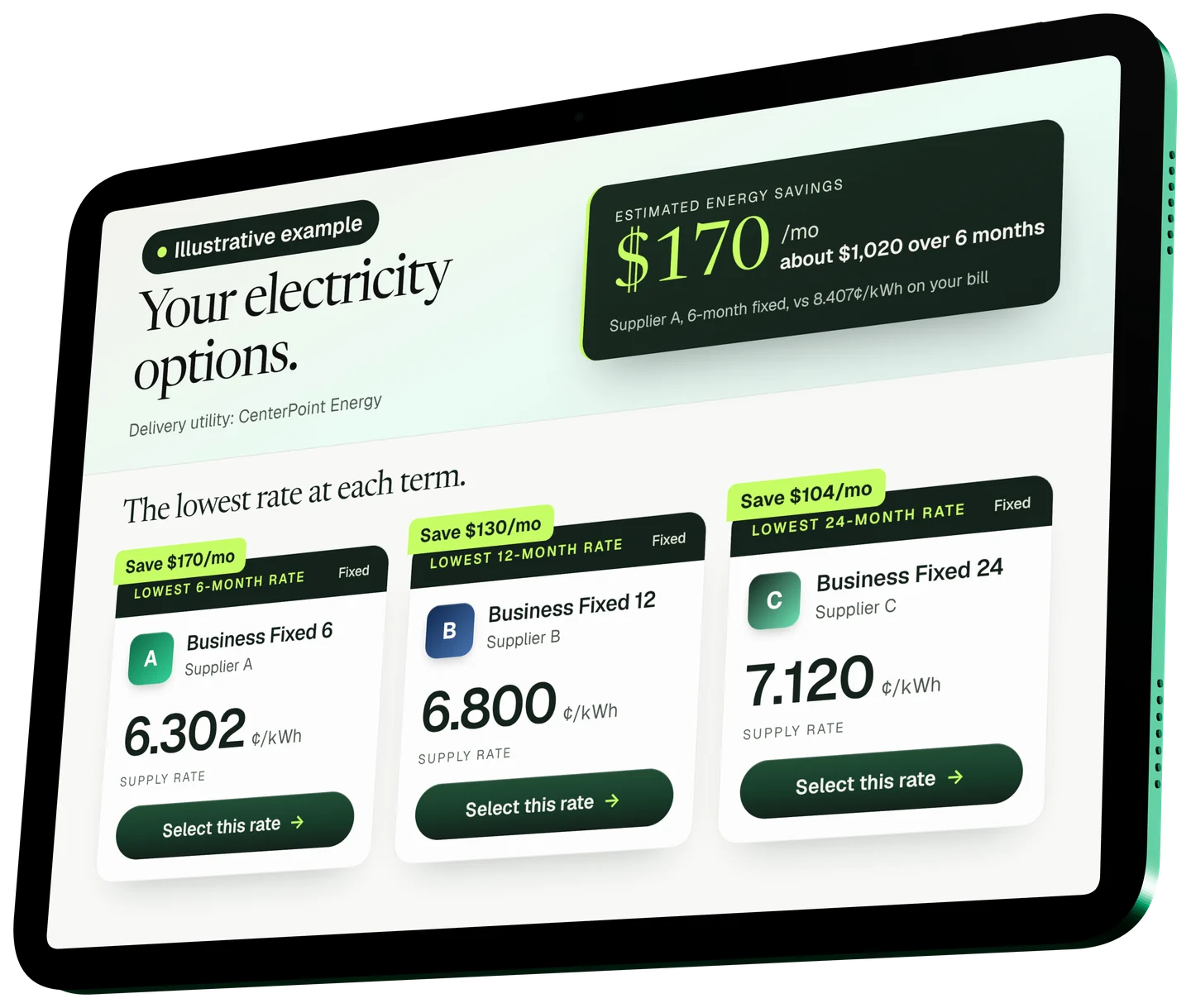
How we compare
Review energy rates, included charges and contract terms together.
See live Texas rates for your ZIP. Fast. No signup. No obligation.
Voltcheckr LLCPUCT broker BR260102Broker disclosures
Business suppliers we shopAvailability varies by account.
 TXU Energy
 Constellation Energy
 NRG Energy
 Shell Energy
 Engie
 NextEra Energy
 AP Gas & Electric
 BP Energy
 Gridmatic Retail
 Hudson Energy
 Major Energy
 SFE Energy
 Summer Energy
 TriEagle Energy
 Value Power
 World Kinect
A Texas business’s experience
“Voltcheckr was quick, easy and saved my business thousands!”
BasisProjected, not yet realized. Savings vary by account and market. Details of this projection in the customer story
Mike Owner, On the Rocks Italian Bistro
Burleson, Texas
YOUR NEXT STEP
Have the service address, meter and start date ready, or time a switch to your current end date.
Existing space checklist
Find the service address and ESI ID on an existing bill.
Choose a supplier and start date. Your supplier sends the order to CenterPoint.
Ask the supplier about credit and deposit requirements before signing.
Review your current terms before choosing a new start date.
Find the end date, notice window and any early termination fee.
Have a recent bill and your ESI ID ready so the offer can be matched to your service address.
Review the new contract and confirm the service date before committing.
Credit review and deposit requirements vary by supplier.
Rates priced for your utility, your renewal month and, with a bill, your usage.
Fixed supply rates, each with its supplier, term and start month. The supplier's contract shows the full terms before you sign.
Pick an emailed rate and sign up on our site with your yearly usage or a recent bill (some plans need the bill). The supplier's contract then comes by email to sign.
Emails start about 90 days before your contract ends, or right away if it is closer, so you can renew before it rolls to a month-to-month rate that can cost more.
Rates in your inbox before you renew. Stop anytime.
Broker disclosure: Voltcheckr LLC is an independent energy broker (Texas PUCT Broker Registration BR260102), not an energy supplier, with no affiliated supplier. The supplier you choose pays us a commission that is included in your quoted rate, and you contract directly with that supplier. You can stop using Voltcheckr at any time at no cost. By continuing you acknowledge our broker disclosures.
An existing space has one on its last bill. For new construction, CenterPoint creates it once the service request is in (713-207-2222 for a business owner's request). The quote form on this page can look it up from the service address.
Choose a retail electricity supplier, which sends the service order to CenterPoint. If a meter is already installed, ask the supplier to arrange service for your requested start date. If a new meter is needed, CenterPoint says installation is usually within 3 to 5 business days of the requested date, weather and workload permitting. Coordinate that date with any required final inspection and utility release.
With no bill yet, a supplier prices the term from a projected figure. The usage estimator turns square footage and business type into one, labelled as an estimate.
For new construction or electrical work that requires a release, complete the required inspections before energization. Inside Houston, contact the Houston Permitting Center's Electrical Inspections section. In unincorporated Harris County, power release follows the required inspections through ePermits. For an existing space with a meter, confirm whether any release is needed for your particular address or work; a supplier change alone does not mean you need a new meter.
In unincorporated Harris County, in order:
Checked November 23, 2026.
Under 16 TAC 25.478 a supplier sets its own credit criteria for a business and may require a deposit. The rule caps a home deposit but not a business one, requires interest on it, and refunds it after 24 consecutive billings with no late payment.
CenterPoint's tariff lists Houston among the incorporated communities it serves. The City of Houston also lists Entergy Texas among the electric utilities it regulates inside city limits. The utility on your bill settles it for your address, and a business on CenterPoint's lines chooses its supplier.
Checked November 23, 2026.
Sources: CenterPoint Energy, Start Electric Service (the supplier sends the order; meters usually installed within 3 to 5 business days; CenterPoint does not sell electricity); Houston Permitting Center, Electrical Inspections; Harris County ePermits, Power Release; Harris County Engineering, Compliance and Steps to Compliance (last updated February 6, 2024); Public Utility Commission of Texas, 16 TAC 25.478. Credit and deposit reference read September 24, 2026; service-order and inspection guidance rechecked November 6, 2026; Harris County's power release and 16 TAC 25.478 rechecked November 26, 2026.
LARGER ENERGY NEEDS
Suppliers bid for your contract on the terms you set. We help you compare the custom prices.
For accounts over 100,000 kWh a year
Need help? Call (469) 708-9311
We review your application and help set your contract terms.
Receive custom prices from suppliers by email as they arrive.
Review the contract with us before you sign.
Eligibility review and authorization are required. Supplier participation varies.
BUSINESS ELECTRICITY
See rates, terms and what’s included, at the same usage.
See how your bill adds upBusinesses in Texas retail-choice areas can choose their electricity supplier. Available offers depend on your service address, usage and contract timing.
| Illustrative comparisonZIP 77024 | Example A12-month term | Example B24-month term |
|---|---|---|
| Fixed energy rate | 6.20¢/kWh | 6.45¢/kWh |
| Energy | $93.00 | $96.75 |
| CenterPoint delivery | $64.97 | $64.97 |
| Monthly utility charge | $4.96 | $4.96 |
| Illustrative monthly bill | $162.93 | $166.68 |
| Average price | 10.86¢/kWh | 11.11¢/kWh |
A CenterPoint account at 10 kVA or less, before taxes. How an offer shows delivery differs by supplier, so ask us and we’ll check each offer.
Updated .
1,500 kWh per month. Example A: an illustrative bill of $162.93, or 10.86 cents per kWh. Example B: an illustrative bill of $166.68, or 11.11 cents per kWh. Before taxes and other account-specific charges.
UNDERSTAND YOUR COSTS
Energy, delivery and the monthly charge: Example A comes to about $162.93 at 1,500 kWh, before taxes and other account-specific charges.
Two parts: the energy rate from the supplier you choose, which you compare here, and CenterPoint’s delivery, about 4.33¢ per kWh plus $4.96 a month for accounts at 10 kVA or less.
Cite as: Voltcheckr LLC, CenterPoint delivery charges for Houston businesses at 10 kVA or less (CenterPoint tariff, checked November 16, 2026), voltcheckr.com/business-electricity/houston#houston-bill-example.
CenterPoint bills delivery to your supplier, which includes it on your electricity bill. An offer may bundle delivery into its price or list it separately. This example adds the tariff charges and credits below; the monthly charge is separate.
The $4.96 monthly charge includes a $2.01 customer charge and a $2.95 metering charge for one meter. The municipal-account credit is excluded.
Current delivery charges. Actual pricing and delivery charges vary by account and market.
This example uses the schedule for secondary-service accounts whose highest 15-minute demand is no more than 10 kVA this month and in each of the previous eleven months.
Accounts above that threshold use a different schedule with demand charges based on kVA. A monthly kWh total alone cannot price that bill; check the demand and service-class lines on your bill. Power factor can also affect billed demand under the applicable tariff.
For eligible larger accounts, transmission charges can depend on 4CP: the account’s demand during ERCOT’s four summer peaks. This method does not apply to every account above 10 kVA.
Multiply monthly usage by the energy and delivery rates, then add the monthly charge. Divide that amount by usage to get the estimated average price per kWh.
Delivery is calculated at 4.3312¢ per kWh. The 6.20¢ energy rate is an illustration, not a live supplier offer. Taxes and any other account-specific charges are excluded. Figures are rounded for display.
Your monthly bill changes with usage, even when the energy rate is fixed. Utility riders can also change when new tariff rates take effect.
Ancillary services, congestion and ERCOT fees may be included in the quoted price or passed through separately. The supplier’s contract identifies which charges are fixed, which can change and how they are calculated.
Taxes and other account-specific fees are excluded from this example. See the Texas business FAQ for answers to common electricity questions.
Example A, a 12-month fixed-rate example. Before taxes and other account-specific charges.
| Bill component | |||
|---|---|---|---|
| Energy | $93.00 | $186.00 | $310.00 |
| Utility delivery | $64.97 | $129.94 | $216.56 |
| Monthly utility charge | $4.96 | $4.96 | $4.96 |
| Illustrative monthly bill | $162.93 | $320.90 | $531.52 |
| Average price | 10.86¢/kWh | 10.70¢/kWh | 10.63¢/kWh |
Houston electricity choice
If CenterPoint delivers to your address, you choose your supplier from those serving its area, and CenterPoint still delivers the power.
Options depend on your service address.
WHY VOLTCHECKR
Voltcheckr LLC is a Texas PUCT-registered electricity broker (BR260102) with no affiliated supplier.
Review energy rates, included charges and contract terms together.
Start with your ZIP, usage and contract timing.
Look at the energy rate, contract length and what’s included.
Continue online where available, or get help with an offer.
No separate fee. Your supplier pays us a commission that is included in your quoted rate.
How Voltcheckr is paid →We use your bill and usage to prepare your quote, and share them with suppliers only with your authorization. We never sell your data.
Our privacy policy →BY INDUSTRY
See what shapes electricity use in your industry.
BEFORE YOU CHOOSE
Rates, contracts and getting started.
For an account whose highest 15-minute demand has stayed at or under 10 kVA for 12 months, this one included, CenterPoint's tariff sets delivery at 4.3312¢ per kWh plus $4.96 a month in customer and metering charges (checked November 16, 2026). Its riders can change when new tariff rates take effect, and an account above 10 kVA is billed on its demand in kVA under another schedule. Delivery is billed under CenterPoint's PUCT-approved tariff, and how delivery, demand and other pass-through charges appear in an offer differs by supplier, so ask us and we'll check each offer.
Source: CenterPoint Energy, Tariff for Retail Delivery Service (checked November 16, 2026)
Each Houston business gets its own supply rate: suppliers price an account from its usage, load shape, term and start month, and their prices move with the wholesale market, so no single figure is your offer. A published average, such as the EIA's figure for Texas businesses, covers a past month and includes delivery, so it is not a supply rate. The average Texas commercial account paid 8.47¢ per kWh all-in in July 2026 (EIA); a quote pricing supply alone does not compare with it. Enter your ZIP to see today's supply offers priced at your usage, side by side.
Source: U.S. Energy Information Administration, Electric Power Monthly, table 5.6.A
Compare at your own usage: the comparison opens on the lowest estimated cost for your usage among the offers we can show for your address. A lower price per kWh does not always mean a lower total: a usage bandwidth, pass-through charges or an early termination fee can change what a contract costs, so compare every offer on the same term and start month. Enter your ZIP or send one bill, and the results price each offer at your usage, side by side, with its fees.
No separate fee. Your supplier pays us a commission that is included in your quoted rate. It is a per-kWh amount inside the rate the supplier quotes. Voltcheckr LLC is a PUCT-registered broker (BR260102), and the commission is paid by the supplier you choose. You see live supplier rates by ZIP, or send one bill for a quote, and you sign only with the supplier.
A good rate is the lowest offer for your own usage once every offer is compared on the same term and start month, with its fees, usage bandwidth and pass-through charges read. A published average is not the test: the EIA's figure for Texas businesses covers a past month and includes delivery, while a supplier's quote may price supply alone, so the two do not compare.
In kVA, from the highest 15-minute interval of the month. Once an account's peak passes 10 kVA, CenterPoint bills its distribution charge on each month's peak kVA for at least 12 months; an account pays delivery per kWh only while its peak stays at or under 10 kVA this month and in each of the previous 11 months. kVA reads at or above kW, and a power factor below 0.95 can raise billed demand. Staggering when heavy equipment starts can keep the peak lower.
It turns on the kWh the business uses: across Texas, the average commercial account paid about $840 a month from July 2025 to June 2026, by our arithmetic on preliminary EIA data. That figure is all-in, delivery included, so it does not compare with a supply-only quote, and it mixes corner stores with hospitals, so a small office's bill can sit far below it. For your own figure, multiply your monthly kWh by the average price line a small commercial bill prints.
Source: U.S. Energy Information Administration, Electric Power Monthly, table 5.6.A
4CP is how ERCOT shares the cost of the high-voltage transmission grid among larger accounts. It uses the 15-minute interval of highest grid demand in each of June, July, August and September. On CenterPoint's tariff, an account whose demand has passed 700 kVA pays transmission on its demand at those four peaks in the previous year, fixed from February for 12 months, so using less power during those intervals can lower the next year's charge. Smaller accounts pay transmission on their own monthly peak or their kWh, and the PUCT is reviewing 4CP under Senate Bill 6.
State and local sales tax, a gross receipts tax reimbursement that depends on the city's population, and the PUC assessment. A meter used mainly for manufacturing may qualify for a sales tax exemption with a predominant use study. Your supplier lists each one on the bill.
Yes. A commercial account whose service address is delivered by CenterPoint picks its retail electricity supplier and contract term under Texas competition, and delivery stays with CenterPoint under its PUCT-approved tariff whichever supplier it signs with. Eligibility follows the utility named on the bill; an address served by a municipal utility or an electric cooperative that has not opted into retail competition does not shop retail suppliers.
Compare every offer on the same term and start month: the supply price per kWh, whether it is fixed for the whole term, any usage bandwidth, and the early termination fee. How delivery, demand and pass-through charges appear in an offer differs by supplier, and the supplier's contract shows them before you sign, so ask us and we'll check each offer. A kitchen's demand peaks when ovens, fryers, dishwashers and HVAC run together during service, and a restaurant that has not opened can be quoted from projected usage.
The supplier list on this page names the suppliers Voltcheckr shops for Texas businesses. Not every supplier bids on every account: availability turns on the delivery utility, usage and load shape, the supplier's credit review and what it is quoting that week, so a name on a list is not an offer. Enter your ZIP or send one bill to see which offers match a Houston account.
Your contract decides it, and usually the account moves to the supplier's month-to-month rate, often called a holdover rate, until you sign again. For a small commercial account (peak demand under 50 kW), Texas rules require at least three written expiration notices, the last at least 14 days before the end date, and with no action the account moves to a month-to-month product it can cancel without a fee. Shop 6 to 12 months before the end date.
CenterPoint Energy delivers electricity to the Houston addresses on its lines (Houston metro and surrounding Southeast Texas), and at those addresses it stays your delivery utility whichever supplier you sign with. Delivery is billed under CenterPoint Energy's PUCT-approved tariff, and how those charges, demand charges and other pass-throughs appear in an offer differs by supplier, so ask us and we'll check how each offer treats them; the supply contract is the part a business shops.
For a standard account: the service address or ESI ID, one recent bill or your monthly kWh, and the date your current contract ends if you have one; a new location with no usage history can be quoted from a projected usage figure. Suppliers routinely ask for more usage history and run a credit review before eligibility and final pricing are settled, and a deposit can apply to a new business account. There is no separate fee for Voltcheckr's service; the supplier you sign with pays the commission.
It can. Under 16 TAC 25.478 a supplier sets its own credit criteria for a business and may require a deposit; the rule caps a home deposit but not a business one, requires interest on it, and refunds it after 24 consecutive billings with no late payment. Ask each supplier what it requires before you sign.
A broker shops the supply contract: Voltcheckr prices offers from several suppliers at your usage, sets their terms side by side and carries the paperwork to your signature with the supplier you choose. It cannot lower CenterPoint's delivery charges, which its PUCT-approved tariff sets, or your taxes, and no supplier changes who restores your power. Whether it is worth it shows in the offers, so set them beside any quote a supplier gives you directly, on the same term and start month.
Source for the average: EIA electricity data
Reviewed November 23, 2026 by Voltcheckr Research.
KEEP EXPLORING
Choice follows the service address and the utility named on the bill, never the city name alone.
Opening a restaurant, usage by business type and nearby markets, each in a short guide.
Find the service address and ESI ID
An existing space has one on its last bill. For new construction, CenterPoint creates it once the service request is in (713-207-2222 for a business owner's request). The quote form on this page can look it up from the service address.
Check inspection and release requirements
For new construction or electrical work that requires a release, complete the required inspections before energization. Inside Houston, contact the Houston Permitting Center's Electrical Inspections section. In unincorporated Harris County, power release follows the required inspections through ePermits. For an existing space with a meter, confirm whether any release is needed for your particular address or work; a supplier change alone does not mean you need a new meter.
Choose a supplier and arrange the start date
Choose a retail electricity supplier, which sends the service order to CenterPoint. If a meter is already installed, ask the supplier to arrange service for your requested start date. If a new meter is needed, CenterPoint says installation is usually within 3 to 5 business days of the requested date, weather and workload permitting. Coordinate that date with any required final inspection and utility release.
Confirm credit and deposit requirements
Under 16 TAC 25.478 a supplier sets its own credit criteria for a business and may require a deposit. The rule caps a home deposit but not a business one, requires interest on it, and refunds it after 24 consecutive billings with no late payment.
Estimate usage if you do not have a bill
With no bill yet, a supplier prices the term from a projected figure. The usage estimator turns square footage and business type into one, labelled as an estimate.
Estimate a new location's usage
Sources: CenterPoint Energy, Start Electric Service (the supplier sends the order; meters usually installed within 3 to 5 business days; CenterPoint does not sell electricity); Houston Permitting Center, Electrical Inspections; Harris County ePermits, Power Release; Harris County Engineering, Compliance and Steps to Compliance (last updated February 6, 2024); Public Utility Commission of Texas, 16 TAC 25.478. Credit and deposit reference read September 24, 2026; service-order and inspection guidance rechecked November 6, 2026; Harris County's power release and 16 TAC 25.478 rechecked November 26, 2026.
Start the account before opening night.
If you will serve alcohol, apply to the Texas Alcoholic Beverage Commission early: it puts processing at about 30 to 35 days from a complete application, and it can take longer. A 60-day outdoor sign is needed only if the location has held no on-premises license or permit in the two years before TABC's first review. Coolers and hoods run before the kitchen is stocked, so ask for a term that starts with the first full month of service.
Know what a kitchen's demand does to the bill.
Ovens, fryers, dishwashers, refrigeration and HVAC running together during service can set the month's peak, which a demand-billed account pays for under CenterPoint's tariff. How demand and delivery appear in an offer differs by supplier, so ask us and we'll check each offer.
Get quoted before you open.
Suppliers price an unopened restaurant from projected usage (square footage, seats, hours and equipment), run a credit review and may ask for a deposit. Send the opening month and the service address with the request.
Restaurant electricity in TexasDemand charge calculator
Sources: Texas Alcoholic Beverage Commission, license and permit FAQs (processing time, when the 60-day sign applies); CenterPoint Energy, Start Electric Service and Tariff for Retail Delivery Service. Read September 24 and October 2, 2026; the TABC FAQs rechecked November 26, 2026.Official documents: TABC: license and permit FAQs
| Business type | kWh a month | 0.5¢/kWh, a year |
|---|---|---|
| Warehouse5.8 kWh per sq ft a year × 25,000 sq ft | 12,100 | $726 |
| Medical clinic17.4 kWh per sq ft a year × 5,000 sq ft | 7,300 | $438 |
| Restaurant43.8 kWh per sq ft a year × 3,000 sq ft | 11,000 | $660 |
| Retail store13.7 kWh per sq ft a year × 4,000 sq ft | 4,600 | $276 |
Estimates from EIA CBECS 2018 intensities at a typical footprint, not a published statistic. The last column is what each 0.5¢ per kWh on the supply rate is worth over a year at that use. Each row is the intensity times the floor area, divided by 12 and rounded to the nearest 100 kWh. Estimate your own space
More business types: Professional offices, Places of worship
These are the PUCT's definitions for a small commercial account, one with a peak demand under 50 kW. Its plan's Electricity Facts Label must say whether the product is a fixed rate or a variable price product. A larger account's contract sets its own terms.
| Product | When the price can change | Rule |
|---|---|---|
| Fixed rate | The price is the same in every billing period of a term of at least three months. It may vary only for actual changes in TDU charges, in ERCOT or Texas Regional Entity administrative fees, or in fees and costs that new or changed laws put on the provider. | 16 TAC 25.475(b)(5) |
| Variable price | The price may vary by a method the provider sets. A month-to-month contract, one with a term of 31 days or less, may not carry a termination fee. | 16 TAC 25.475(b)(7), (b)(11) |
| Indexed | The price follows a disclosed formula based on publicly available indices or information. Not offered to a small commercial account: the rule bars providers, aggregators and brokers from offering one, so it is for larger accounts only. | 16 TAC 25.475(b)(6), (c)(3)(F) |
Source: PUCT rule 16 TAC 25.475, definitions and contract requirements (PDF). Checked November 23, 2026. Source: PUCT rule 16 TAC 25.471(d)(11), small commercial customer (PDF). Checked November 23, 2026.
Compare available rates and terms. Start with your business ZIP.
Need help? Call (469) 708-9311
Voltcheckr LLCPUCT Broker Registration BR260102No separate fee, the supplier pays usBroker disclosures