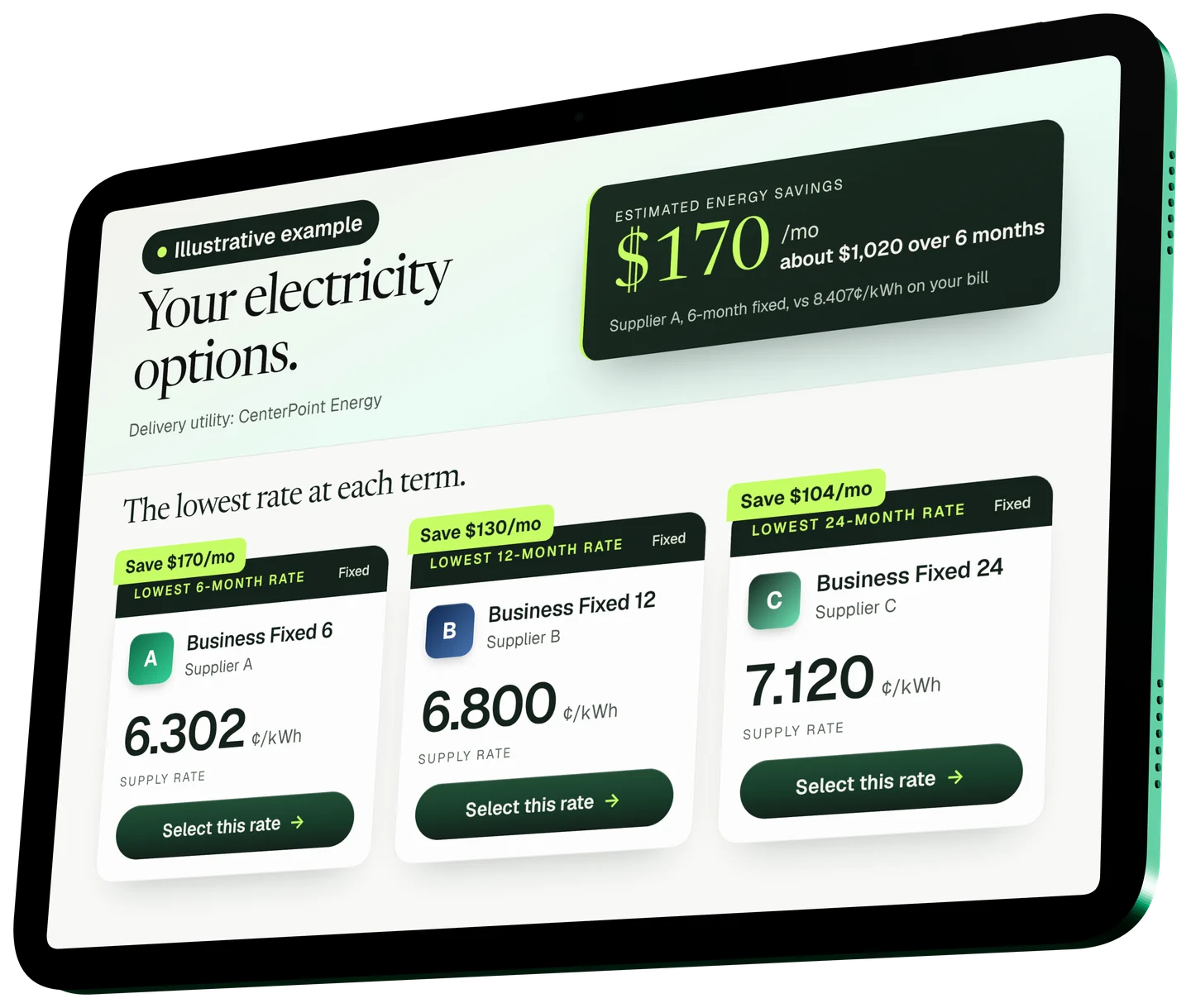
How we compare
Review energy rates, included charges and contract terms together.
See live Texas rates for your ZIP. Fast. No signup. No obligation.
Voltcheckr LLCPUCT broker BR260102Broker disclosures
Business suppliers we shopAvailability varies by account.
 TXU Energy
 Constellation Energy
 NRG Energy
 Shell Energy
 Engie
 NextEra Energy
 AP Gas & Electric
 BP Energy
 Gridmatic Retail
 Hudson Energy
 Major Energy
 SFE Energy
 Summer Energy
 TriEagle Energy
 Value Power
 World Kinect
A Texas business’s experience
“Voltcheckr was quick, easy and saved my business thousands!”
BasisProjected, not yet realized. Savings vary by account and market. Details of this projection in the customer story
Mike Owner, On the Rocks Italian Bistro
Burleson, Texas
YOUR NEXT STEP
Have the service address, meter and start date ready, or time a switch to your current end date.
Existing space checklist
Find the service address and ESI ID on an existing bill.
Confirm the start date and service order with your chosen supplier.
Ask the supplier about credit and deposit requirements before signing.
Review your current terms before choosing a new start date.
Find the end date, notice window and any early termination fee.
Have a recent bill and your ESI ID ready so the offer can be matched to your service address.
Review the new contract and confirm the service date before committing.
Credit review and deposit requirements vary by supplier.
Rates priced for your utility, your renewal month and, with a bill, your usage.
Fixed supply rates, each with its supplier, term and start month. The supplier's contract shows the full terms before you sign.
Pick an emailed rate and sign up on our site with your yearly usage or a recent bill (some plans need the bill). The supplier's contract then comes by email to sign.
Emails start about 90 days before your contract ends, or right away if it is closer, so you can renew before it rolls to a month-to-month rate that can cost more.
Rates in your inbox before you renew. Stop anytime.
Broker disclosure
Voltcheckr LLC is an independent energy broker (Texas PUCT Broker Registration BR260102), not an energy supplier, with no affiliated supplier. The supplier you choose pays us a commission that is included in your quoted rate, and you contract directly with that supplier. You can stop using Voltcheckr at any time at no cost. By continuing you acknowledge our broker disclosures.
Use a recent bill to confirm the service address, utility and ESI ID, the identifier for your electricity service point. For a new location, ask the local utility to confirm the meter setup.
Review the contract and confirm the requested start date with your supplier. For a move, check the stop date at your old location separately.
Use recent electricity bills when available. For a new location, prepare an estimate based on your space, equipment and operating hours. An estimate is not a guaranteed bill.
Before scheduling service at a new or renovated location, check any inspection and power-release requirements with the local utility and permitting authority. Requirements depend on the address and work involved.
Credit review and deposit requirements vary by supplier. Ask what is required for your business and review the terms before signing.
Businesses in Texas retail-choice areas can choose their electricity supplier. Options depend on the service address and utility, not the city name alone.
LARGER ENERGY NEEDS
Suppliers bid for your contract on the terms you set. We help you compare the custom prices.
For accounts over 100,000 kWh a year
Need help? Call (469) 708-9311
We review your application and help set your contract terms.
Receive custom prices from suppliers by email as they arrive.
Review the contract with us before you sign.
Eligibility review and authorization are required. Supplier participation varies.
BUSINESS ELECTRICITY
See rates, terms and what’s included, at the same usage.
See how your bill adds upBusinesses in Texas retail-choice areas can choose their electricity supplier. Available offers depend on your service address, usage and contract timing.
| Illustrative comparisonZIP 77024 | Example A12-month term | Example B24-month term |
|---|---|---|
| Fixed energy rate | 6.20¢/kWh | 6.45¢/kWh |
| Energy | $93.00 | $96.75 |
| CenterPoint delivery | $64.97 | $64.97 |
| Monthly utility charge | $4.96 | $4.96 |
| Illustrative monthly bill | $162.93 | $166.68 |
| Average price | 10.86¢/kWh | 11.11¢/kWh |
A Houston CenterPoint account at 10 kVA or less, before taxes. How an offer shows delivery differs by supplier, so ask us and we’ll check each offer.
Updated .
1,500 kWh per month. Example A: an illustrative bill of $162.93, or 10.86 cents per kWh. Example B: an illustrative bill of $166.68, or 11.11 cents per kWh. Before taxes and other account-specific charges.
UNDERSTAND YOUR COSTS
Energy, delivery and the monthly charge: Example A comes to about $162.93 at 1,500 kWh, before taxes and other account-specific charges.
CenterPoint bills delivery to your supplier, which includes it on your electricity bill. An offer may bundle delivery into its price or list it separately. This example adds the tariff charges and credits below; the monthly charge is separate.
The $4.96 monthly charge includes a $2.01 customer charge and a $2.95 metering charge for one meter. The municipal-account credit is excluded.
Current delivery charges. Actual pricing and delivery charges vary by account and market.
This example uses the schedule for secondary-service accounts whose highest 15-minute demand is no more than 10 kVA this month and in each of the previous eleven months.
Accounts above that threshold use a different schedule with demand charges based on kVA. A monthly kWh total alone cannot price that bill; check the demand and service-class lines on your bill. Power factor can also affect billed demand under the applicable tariff.
For eligible larger accounts, transmission charges can depend on 4CP: the account’s demand during ERCOT’s four summer peaks. This method does not apply to every account above 10 kVA.
Multiply monthly usage by the energy and delivery rates, then add the monthly charge. Divide that amount by usage to get the estimated average price per kWh.
Delivery is calculated at 4.3312¢ per kWh. The 6.20¢ energy rate is an illustration, not a live supplier offer. Taxes and any other account-specific charges are excluded. Figures are rounded for display.
Your monthly bill changes with usage, even when the energy rate is fixed. Utility riders can also change when new tariff rates take effect.
Ancillary services, congestion and ERCOT fees may be included in the quoted price or passed through separately. The supplier’s contract identifies which charges are fixed, which can change and how they are calculated.
Taxes and other account-specific fees are excluded from this example. See the Texas business FAQ for answers to common electricity questions.
Example A, a 12-month fixed-rate example. Before taxes and other account-specific charges.
| Bill component | |||
|---|---|---|---|
| Energy | $93.00 | $186.00 | $310.00 |
| Utility delivery | $64.97 | $129.94 | $216.56 |
| Monthly utility charge | $4.96 | $4.96 | $4.96 |
| Illustrative monthly bill | $162.93 | $320.90 | $531.52 |
| Average price | 10.86¢/kWh | 10.70¢/kWh | 10.63¢/kWh |
Texas electricity choice
In Texas retail-choice areas, you choose the supplier and contract. Your utility keeps delivering.
Options depend on your service address.
WHY VOLTCHECKR
Voltcheckr LLC is a Texas PUCT-registered electricity broker (BR260102) with no affiliated supplier.
Review energy rates, included charges and contract terms together.
Start with your ZIP, usage and contract timing.
Look at the energy rate, contract length and what’s included.
Continue online where available, or get help with an offer.
No separate fee. Your supplier pays us a commission that is included in your quoted rate.
How Voltcheckr is paid →We use your bill and usage to prepare your quote, and share them with suppliers only with your authorization. We never sell your data.
Our privacy policy →BY INDUSTRY
See what shapes electricity use in your industry.
More industries:Light ManufacturingAuto DealershipsHotels & HospitalityGyms & Fitness CentersSalons & Beauty ServicesCar Washes
Costs and contracts
A storage unit and a cold store use power differently. Compare offers against your warehouse usage, equipment and contract timing.
Tap a row for the detail.
A large footprint means lighting, dock doors and conditioned space can make electricity a major operating expense. Cold storage and refrigerated distribution carry around-the-clock compressor loads, which can raise demand charges where the utility's tariff bills for demand. Dry storage, distribution and cold storage use power very differently, so each is priced on its own usage.
Fixed, index and block-and-index prices carry different risks: a fixed price holds the supply rate for the term, an index price follows the wholesale market, and block-and-index fixes a block of usage while the rest follows the market. Texas rules bar index and block-and-index pricing for small commercial accounts, so those compare fixed offers. For a larger account, which fits depends on how steady your usage is and how much budget risk you can carry. Share planned changes, such as added refrigeration, chargers or longer hours, before suppliers price the account.
In Texas retail-choice territory your delivery utility sets these under its PUCT-approved tariff, and your supplier bills them. How delivery, demand and pass-through charges appear in an offer differs by supplier, so ask us and we'll check each offer.
Start watching your renewal about 18 months before the contract ends and shop it 6 to 12 months out, since suppliers can price a contract to start months ahead. The renewal reminder on this page starts its emails about 90 days out, a backstop before the account can lapse. If a term ends with no new contract, the account usually moves to the supplier's month-to-month rate, often called a holdover rate, until you sign again.
| Type | What to know when you compare |
|---|---|
| Dry storage | Lighting, dock doors and hours, with little conditioned space |
| Distribution center | Shifts, conveyors, dock doors and any forklift charging |
| Cold storage | Refrigeration around the clock, which can raise demand where the tariff bills for it |
Where Texas has retail choice, your delivery utility depends on your service address, not your supplier.
| Utility | Per month | Per kWh |
|---|---|---|
| Oncor10 kW or less | $6.70 | 5.38¢ |
| CenterPoint10 kVA or less | $4.96 | 4.33¢ |
| AEP Texas Central10 kW or less | $5.66 | 4.42¢ |
| AEP Texas North10 kW or less | $5.66 | 4.28¢ |
| TNMP5 kW or less | $8.15 | 1.29¢ |
Choose the starting point that fits your site.
Start with your electricity bills.
A full year helps reveal seasonal changes. You can start comparing before gathering every bill.
Build a planning estimate.
For an expansion, include existing usage plus the added equipment's estimated usage. An estimate is not measured electricity use or demand.
Use the same usage assumptions, contract term and start date. Check how supply, delivery, demand and fixed charges are billed.
Available offers depend on your service address, usage and supplier terms.
BEFORE YOU CHOOSE
Rates, contracts and getting started.
No separate fee. Your supplier pays us a commission that is included in your quoted rate. It is a per-kWh amount inside the rate the supplier quotes. Voltcheckr LLC is a PUCT-registered broker (BR260102), and the commission is paid by the supplier you choose. You see live supplier rates by ZIP, or send one bill for a quote, and you sign only with the supplier.
Use 12 months of actual electricity bills for an operating warehouse. For a new site, multiply each load's electrical input (kW) by its run hours, allowing for equipment that cycles on and off. The result is estimated electricity use (kWh), not measured usage or demand.
Your service address, usage pattern, contract term and start date affect available supplier offers. A supply rate alone may not include delivery, demand or fixed charges. Compare each offer's full charge breakdown, and ask us if a charge is unclear.
Yes, in deregulated ERCOT territory, which includes Oncor's lines in Dallas and Fort Worth, CenterPoint's lines in Houston and much of the state. Eligibility follows the service address and its utility: a municipal utility or an electric cooperative that has not opted into retail competition, such as Austin Energy or CPS Energy in San Antonio, does not offer that choice. Voltcheckr LLC (PUCT broker BR260102) shops the supply contract for you and charges no separate fee; the supplier you choose pays the commission.
It can. Supplier pricing follows how much power an account uses and when, and refrigeration that runs around the clock changes both. Share the refrigerated share of the building and any planned additions when you ask for pricing.
Yes. Each meter has its own ESI ID and can be priced alone or with the others. Comparing a combined bid with separate bids shows which comes out ahead, since renewal dates and usage differ by meter.
Where the ZIP is in Texas retail-choice territory and live plans match your account, your plan options arrive by email within an hour; where none match, the account is priced by custom quote. Custom pricing is prepared the same business day when you ask inside advisor hours (7am–7pm CT, Monday–Saturday), otherwise the next business day.
The average Texas commercial account paid 8.47¢ per kWh all-in, supply and delivery together, versus 14.53¢ nationally (EIA, 07/2026), and used about 9,701 kWh a month (EIA, through 2026). Supplier quotes may price supply alone, so they are not always directly comparable to that all-in average. That usage average mixes corner stores with hospitals, so any one business varies widely. Businesses in deregulated Texas territory choose their electricity supplier, and delivery stays with the local TDU with any supplier.
Source for the average: EIA electricity data
KEEP EXPLORING
Choice follows the service address and the utility named on the bill, never the city name alone.
Compare available rates and terms. Start with your business ZIP.
Need help? Call (469) 708-9311
Voltcheckr LLCPUCT Broker Registration BR260102No separate fee, the supplier pays usBroker disclosures